
Naked Wallabies
Shoes so raw, they age before you wear them.

At 60% off, I just couldn’t miss out. I even shared the insanely good deal on Substack, hoping someone would pick up these beauties. They were begging for a new home. And I should probably practice what I preach.


Seriously though, I’ve been wanting Hender Scheme shoes for years. I gave my wife a laptop sleeve, then a pillow. She gave me home slippers and a camera strap. We like it all in raw, natural vegetable-tanned leather, of course. But it’s really the MIP shoe line that Hender Scheme has become known for.
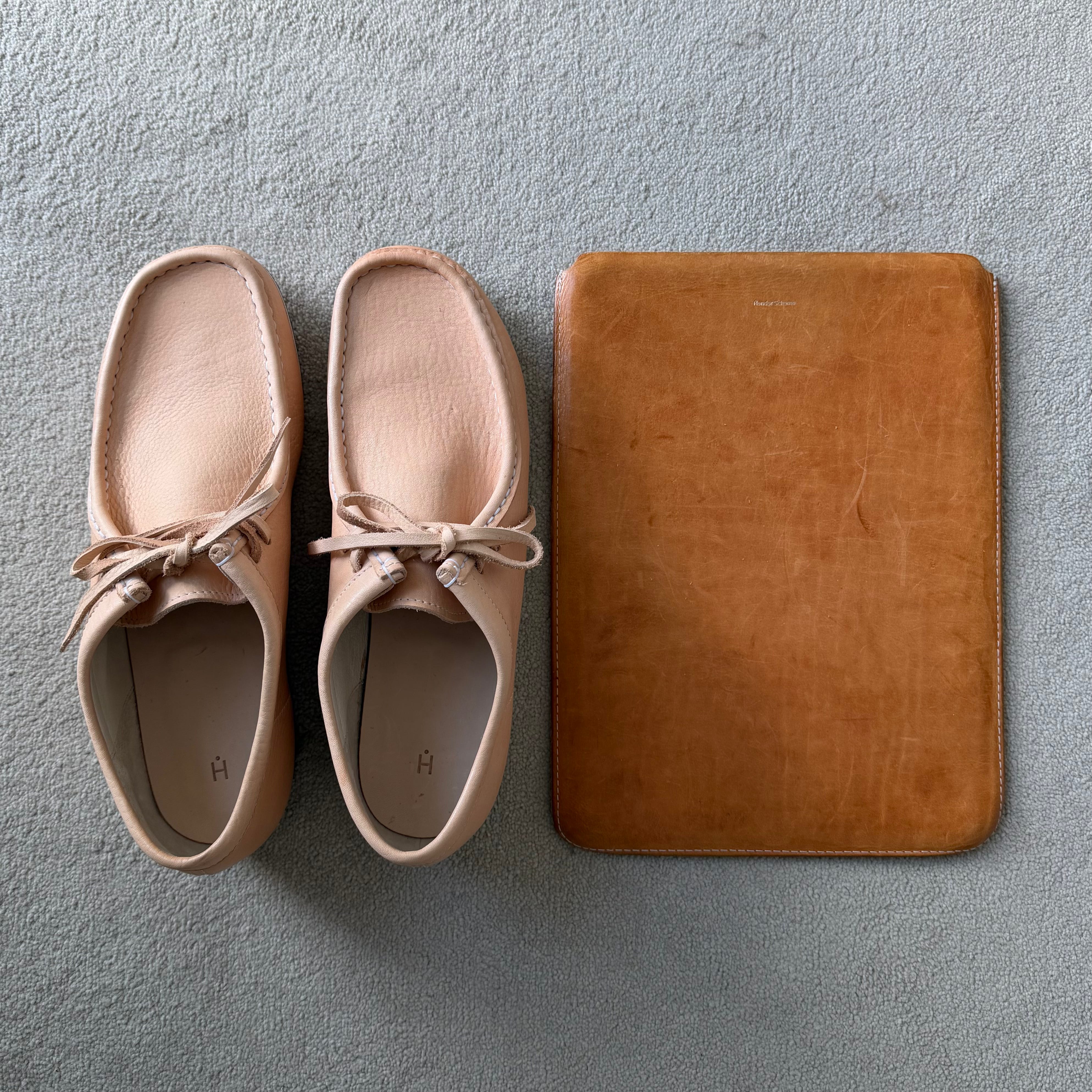
MIP stands for “Manual Industrial Products”: Hender Scheme recreates legendary sneaker silhouettes by hand, in natural veg-tan leather. I think I first discovered their MIP-01 — an honest reproduction of the Nike Air Force 1 — through the now-closed Brooklyn store Gentry (whose selection and styling still feel relevant today). The idea of an iconic silhouette, made in small batches by hand from raw leather that changes drastically over time, completely blew me away.
Here is how the brand’s founder, Ryo Kashiwazaki, described the concept in an interview with Intelligence Magazine (the now-closed print publication by Haven):
I don’t actually regard a brand new pair of Hender Scheme shoes to be in its final and complete form, because it’s made to be used. Ideally, once a person has a pair and starts using them, it becomes their own. They might look nice on display, but it’s a tool meant to be used. The way the sole wears down, whether someone likes their leather dirty or clean, in the end, I see a new pair of Hender Schemes at 80% of its journey. The remaining 20% only takes effect once someone puts them on and starts walking. This is what I believe to be at the foundation of Hender Scheme.

I pretty much think Hender Scheme started the whole microtrend of natural veg-tan sneakers. Just two years after the brand first released the MIP line, their own versions were introduced by Asics, Epaulet, adidas, and Victory Sportswear. Eventually, big companies embraced the artisanal Japanese brand by releasing official collaborations — a rare example of the industry recognizing the game, not fighting it.
Anyway, the philosophy behind MIP resonates with me deeply. It’s exactly the reason why I love raw denim: natural veg-tan leather is the perfect canvas for building a true luxury. Still, I wasn’t prepared for the aging process to begin this soon.
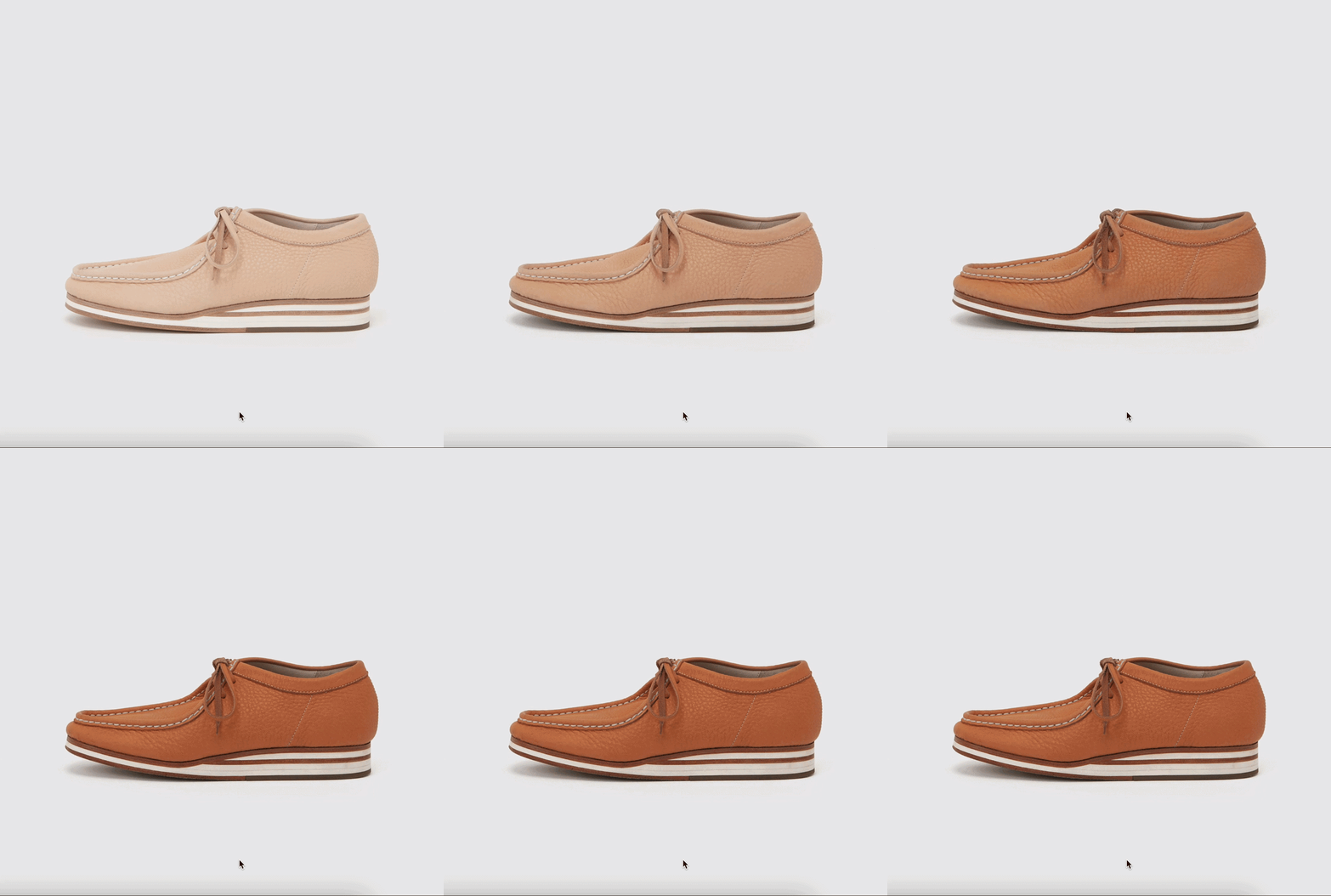
At first, I wanted to interfere as little as possible. I was just going to put them on and let whatever happened, happen. Obviously, I wasn’t going to wear them in the rain, but I decided not to worry about random splashes that would inevitably leave permanent marks — that’s kind of the whole point. Maybe I’d give the leather some nourishment when it felt dry, but only on top of whatever dirt had already built up. Sooner rather than later, this should result in a stained, uneven, beat-up patina. Which is kind of absurd, considering the premium price and the amount of manual labor that went into the product.
But life rarely goes according to plan. The problem with the Hender Scheme MIP shoes is that even the soles are made from raw, natural veg-tan leather. I’m all for dirty patina, but degrading bottoms wouldn’t add much to it. Fortunately, with the MIP 29, Hender Scheme was generous enough to cover at least a third of the riskiest real estate with rubber protection. I’m not sure what distracted them from the remaining part, but it must have been something even more vulnerable.
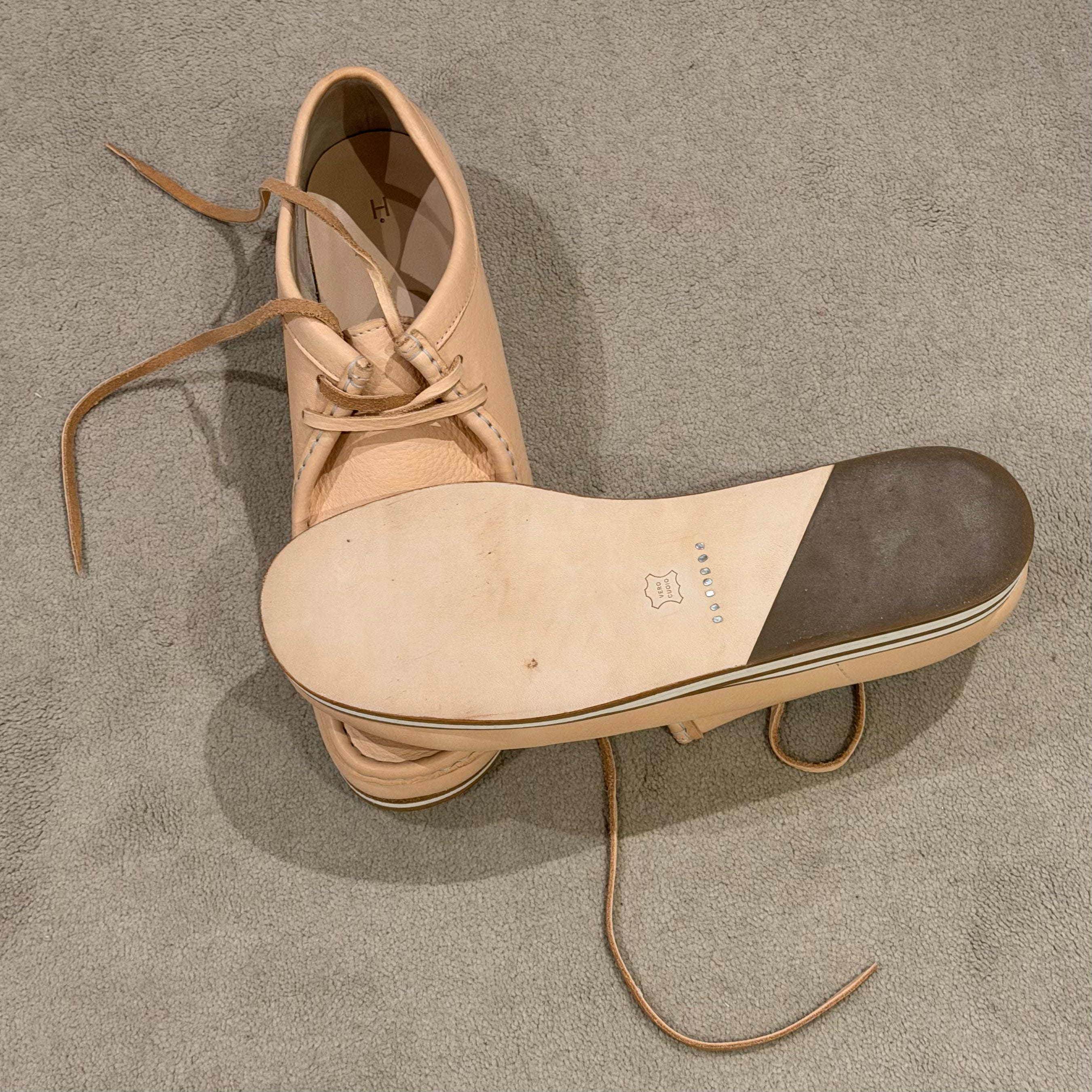
With classic leather-soled shoes, I’d just take them to a cobbler to have steel toe plates put on, without a second thought. But in the case of the MIP 29, that didn’t feel right, despite the fact that this isn’t exactly a sneaker silhouette. Rubber toe taps would probably do the job, but I couldn’t bring myself to operate on that pristine, naked leather. Instead, I opted to nurture it.
I purchased a bottle of Saphir Leather Sole Guard, which is designed specifically to protect leather soles from abrasion and water. I don’t expect Saphir had raw, natural leather soles in mind, but it’s my best bet. I think I’ve already applied almost half the bottle to my Hender Scheme shoes. Saphir recommends letting every second application dry overnight, so the process took a few weeks. Quick reminder: by this point, I still haven’t worn the shoes even once.
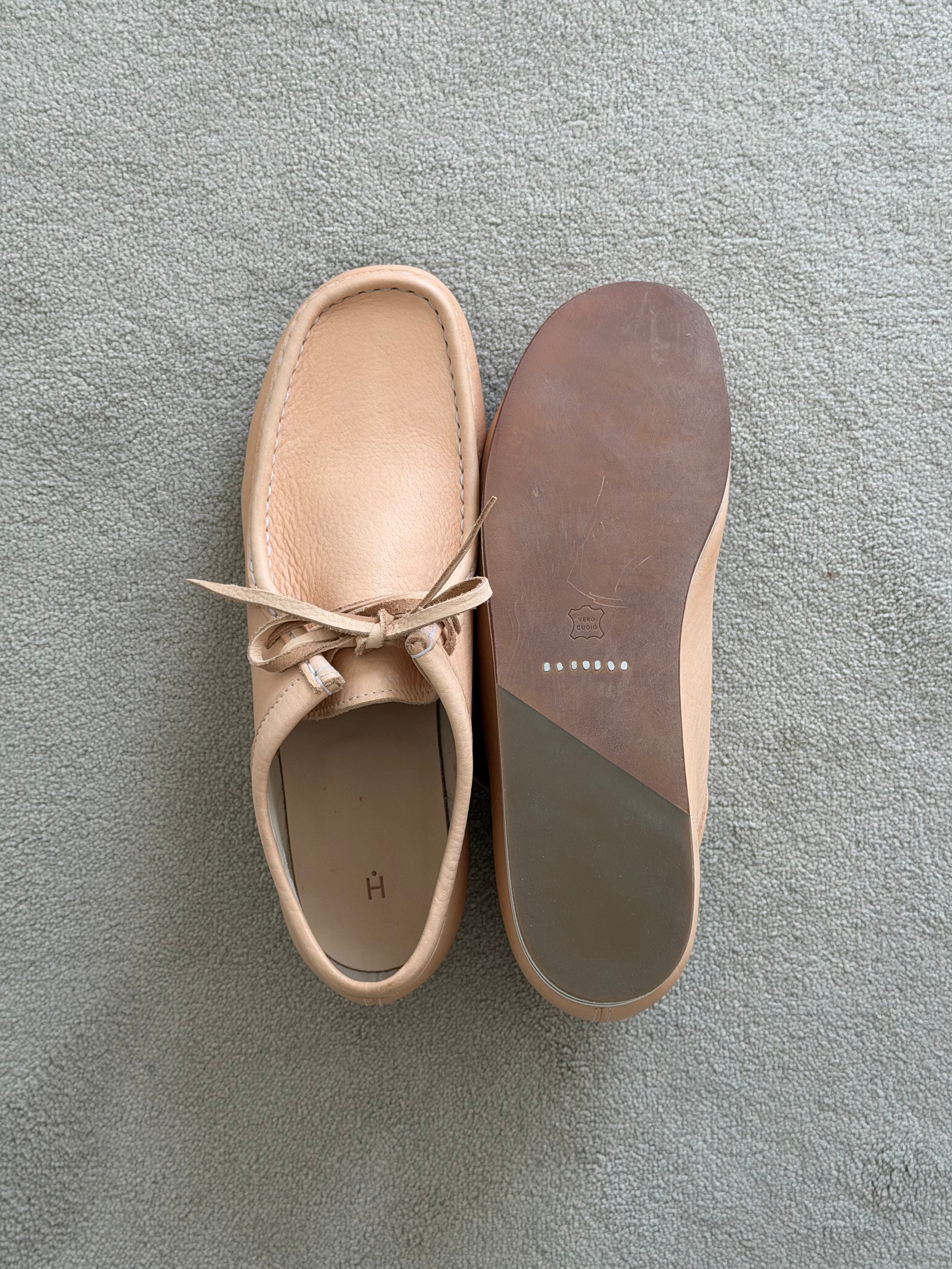
I’m yet to find out how much protection the Sole Guard can actually provide. To be honest, I don’t expect much. Still, the color change from nude beige to milk chocolate brown suggests the soles did absorb the multiple layers I applied. But that came at a cost.
One night, I accidentally left the right shoe touching the cloth I used to apply the Sole Guard. The next morning, I found the toe stained — this leather is so raw that it literally soaked up the product from the cloth. Another day, I stained the left shoe with three tiny droplets of blood from a cut on my finger. I tried applying a tiny amount of cold water and ended up with yet another stain.
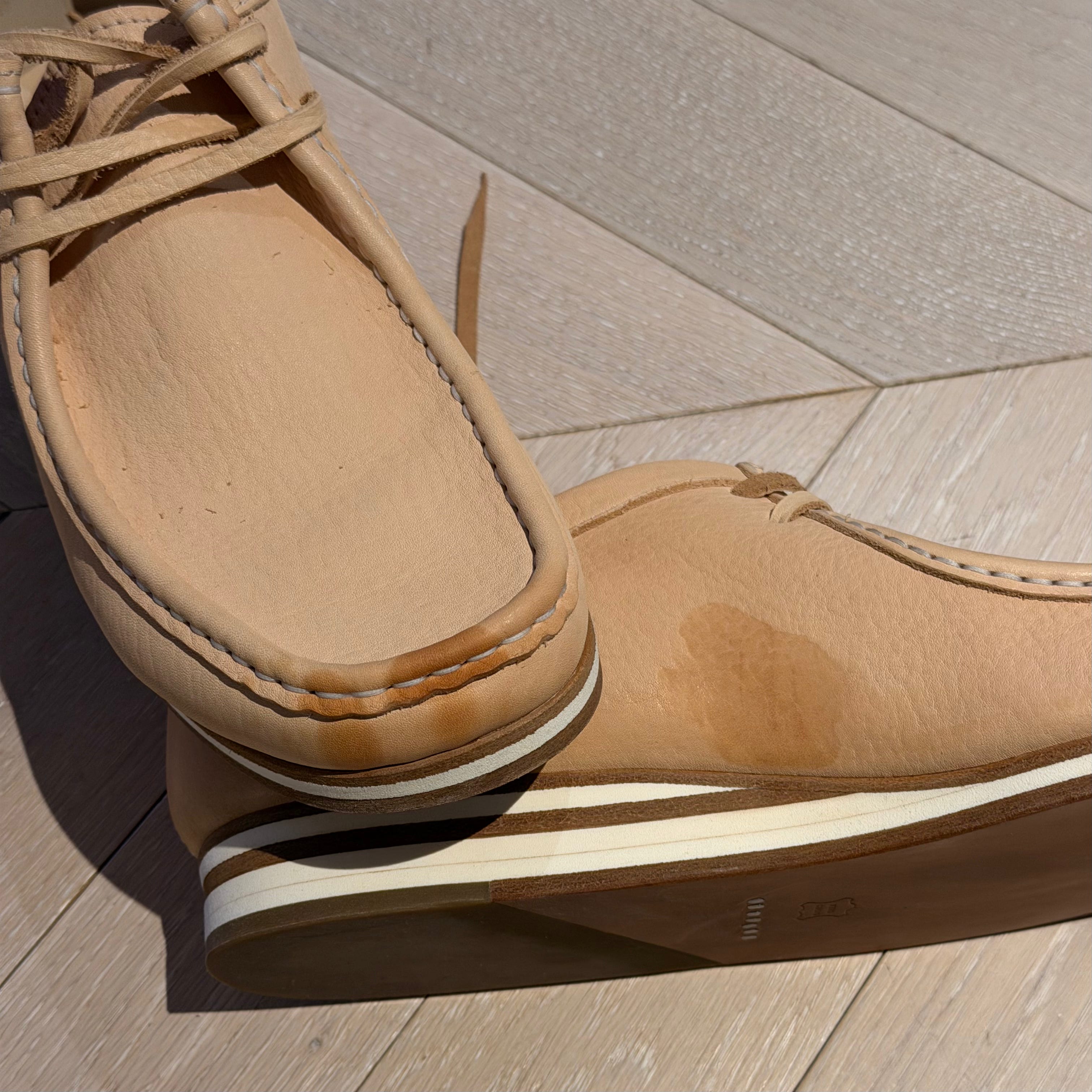
Look, I’m not complaining. It’s just not how I imagined breaking in a new pair of shoes made from raw, natural veg-tan leather. It turned out to be a lot less romantic in reality. It’s one thing to spill a beer on them in a pub. But I haven’t even worn them once.
So, guess what I did next? No, of course I didn’t start wearing them. I had to fix the stains first. I figured there was hardly any way to remove the damage, so I’d better smooth it out. I reached for a neutral cream from Bally — probably the most random shoe product I’ve ever purchased. I’d only used it a few times on my old longwings, but it felt really good on my fingers and smelled nice, too. Not the most scientific approach, I know. But I applied a tiny amount first and left overnight — it hardly affected the color. Then I applied a few thin layers over the stains, trying to blend them in. I had plenty of time, since I was applying the Sole Guard to the soles anyway. Little by little, the stains started to fade, or rather blend into the rest of the leather.
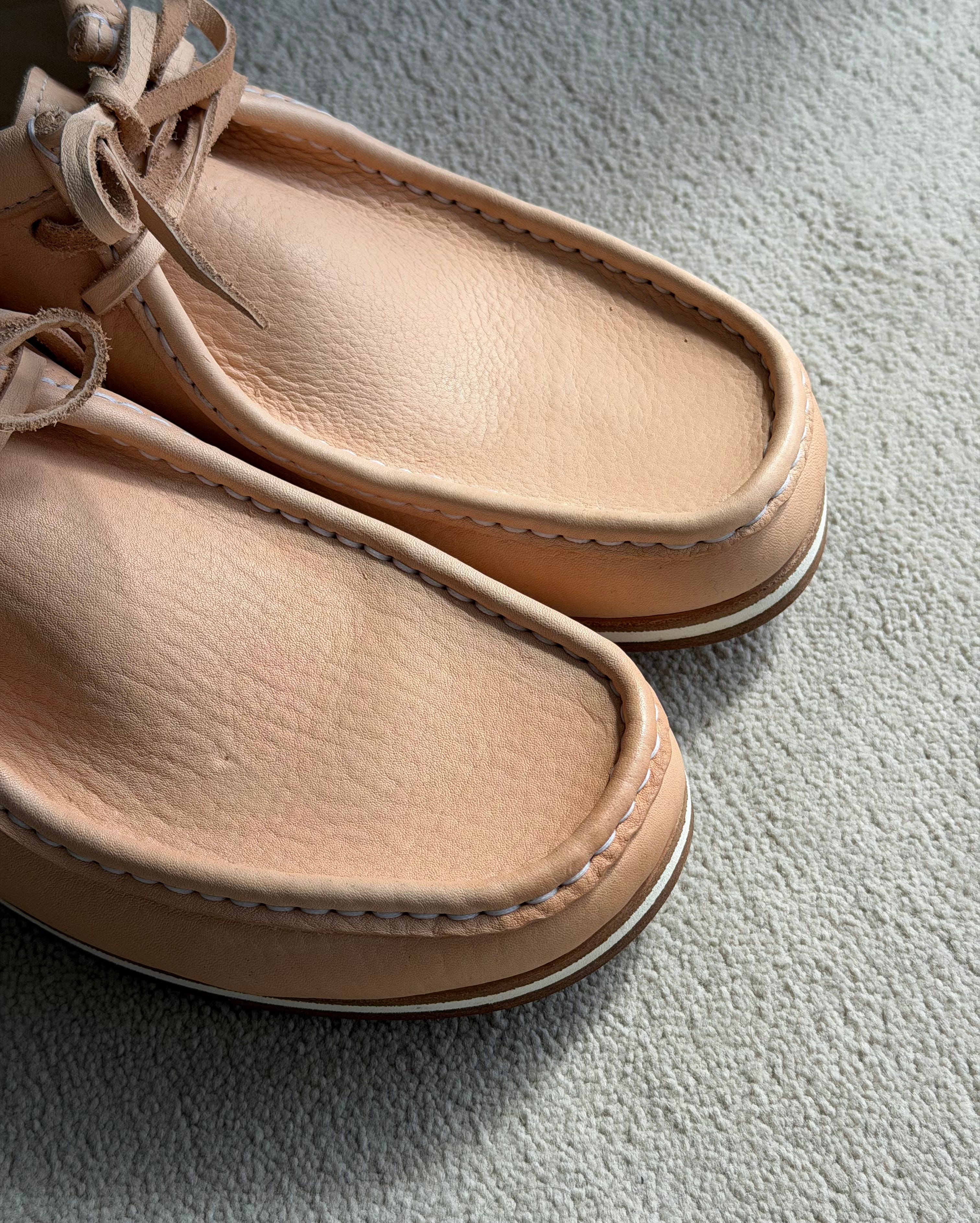
Encouraged by how little the neutral cream changed the color, I faced a hard decision: treat only the stained areas, or apply it all over. On the one hand, the whole point of natural veg-tan leather is to get dirty and stained. On the other hand, I didn’t like those first random marks. So I ended up applying a few thin layers across the entire shoe, except for the moccasin strip and the collar piece. It didn’t change the color much — you can hardly notice the difference — but hopefully it gives the leather some level of protection. Watching how absorbent this natural veg-tan leather is, I don’t really think a neutral cream is capable of blocking the impact of sun, moisture, or dirt.


Now that I’ve shared the story, I’m finally ready to step out into the wild wearing these not-so-pristine, but still pretty naked shoes. You can tell we’ve already been through a lot together, and I’m damn sure we’ve got many more challenges ahead. Challenges that will only make the relationship stronger. One day, they’ll be strong enough to turn into true luxury.
Wish me luck, and I’ll keep you updated on the progress as always.
Do you have clothing that required work before wearing it? Or any upsetting experiences with new items?
Anyway, thank you for reading to the end! If you have any questions or comments about Hender Scheme, please join the conversation in the comments section on Substack.
Lastly, I do my best to document personal stories with clothing. But I really need your help to help others discover it too — it’s more fun to geek out over such things together. I’d greatly appreciate it if you could share this article with your friends and those who might dig it — on Reddits, socials, group chats, and forums. Hitting a ❤️ and restacking it on Substack is huge help and motivation, too!

Luxury Is Quality Multiplied By Time

There is a lot of joy in buying cool stuff. The agitation of yearning for an item. The excitement of making a purchase. The thrill of unpacking. The pleasure of the very first try-on.
Amateur Guide To Classic Shoe Care

I'll admit it right off the bat, I'm no expert. But I've cleaned this particular pair over 20 times. I even attended a shoe-shining masterclass once. Still, before every clean, I check the Hanger Project guides to jog my memory.
I dated a man that, went he got a new pair of wallabies in suede, he would hose them down. This way the entire surface was water stained evenly. I'm not sure whether or not he waterproof them after that. That man took pristine care of his clothing and shoes.
As someone who constantly fights the urge to keep things pristine this read like a horror novel to me.